
Terry and Philippa Rolison have a great interest in music from around the world and we like to try out all sorts of instruments. Terry has studied the sitar and surbarhar for many years with Jonathan Mayer. We have also studied the West African Kora at S.O.A.S. in London. We hope to keep on learning music from different musical cultures.

DVD: West African Music for fingerstyle guitar, Fernando Perez. This is the only DVD I have found on this subjuct. It is for the more advance guitarist (uses open D tuning) for the musical examples. very good for players wanting to explore music normally played by the kora. There is a very good pdf booklet with tab and notation for guitar.


This book is for Ngoni Guitar with tab and notation. Tuning details for 4 to 7 string ngoni's, some simple tunes. This seems to be the only book on the subject
Music Circus Colchester, promoted losts of local musitions but were really interested to see music from India.

Terry Rolison has been studying the sitar for many years and has learnt Indian classical music using the Rag system. I have spent many years learning how to use Indian compositions, Tans and Tihais with the correct drum beats. I performed my first gig this summer in Colchester town centre.
We have 2 koras, a standard 21 string, which is the normal configuration and a 22 string with chromatic levers and a built in pick up.

Kamale Ngoni; this a bass ngoni tuned from f. All our Koras and Ngonis were supplied by Adaptatrap in Brighton, made by Les Shepherd.
The Ngoni guitar has two fretted strings with no frets. There are also 2 to 5 extra strings that are picked or strummed; you can tune the ngoni guitar via leather straps or more recent instruments by guitar type tuners. The ngoni guitar type guitar can be found across most of Africa under different names; Xalam, Kontingo.
There is little music written for the ngoni guitar, so you will need to learn by ear though there is quite a lot on YouTube to listen to. There is one paper back book Learn to play ngoni, by Ramon Goose, who is based in Colchester Essex.
I have a 5 string ngoni which I normally tune F G C G A. This is quite a large instrument compared to the guitars you will see being used on the internet. I have also purchased a 4 string ngoni which can be tuned an octave higher which is more like the modern instruments used in bands today.

Two ngoni guitars made by Adaptatrap
Rear view of African bass guitar
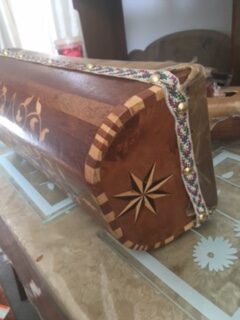
Demo of African bass guitar: this instrument has 3 strings, I have tuned the two main playing strings to D and G, the middle string is tuned an octave highter than lowest D string. I have played this guitar with a Kora tuned to F, it seemed to sound quite good.
Purchased from Adaptatrap in Brighton, this Chinese instrument is Height 112cm and 50cm wide, 4 strings and 24 frets. It was sold as a Da ruan, but maybe a Zhong ruan, I need to find out more.


16th June 2023
I have found a book on the hist.ory of the cigarbox guitar, it seems to be the only one available. It covers 150years of history from the first examples from the 1840's. Also talks about violins, ukes and banjos.

18th May 2023
Found a shamisen teacher in Finchley London. Hibiki Ichikawa will supply instruments, and do face to face, or on-line for Tsugaru shamisen lessons. For more details on go to my World music page
9th May 2023
Just started learning the Shamisen from Japan, will put up lots of information and web links soon.
Useful Shamisen links
Bachido has a lot of useful inforation, including 200 folk tunes for shamisen. It also has a forum and instruments for sale. Not my style but a lot of good stuff. Shamisen of Japan is a lot more serious.
16th April 2023
An 8 stringed Nyatiti, normally made in West Africa. This instrument was made by Adaptrap, a music shop in Brighten UK. It is tuned to G pentatonic, low tohigh; G A B D E G A B. This is a convenient tuning for a western player, the africans tune notes in different


7th April 2023
Just ordered another small kora with built in pickup. This instrument has been made for small hands.

7th April 2023
I am having my Kalamazoo KG14 worked on by NoTom in London. It has had to have a neck reset, which is not unusual for a guitar from c1938. On
Learning to play the shamisen in the UK
Books: All the music books you will find are written in Japanese, but you can use Google Lens to read the text in these books; this works very well. There is one book written in English Shamisen of Japan, by Kyle Abbott, this book contains details on how to build your own shamisen, you will also find music tabs to play.
Tab: If you are a guitarist you will be familiar with Tab. Shamisen is written on 3 lines. Your shamisen should have number stickers up the neck of the instrument showing fret numbers. You can buy a number strip if you need to put one on your instrument. You will need to get used to reading ornaments; such as hammer-ons, slides etc.
Tuning your shamisen: There are three main tunings for the shamisen, you will need to check which tuning before you play your instrument.
Niagari: C G C
Honchoushi: C F C
Sansagari: C F Bflat
There are 4 sizes of Ruan which can be tuned D A D A or the large Da Ruan is tuned G D G D. They are played with a guitar plectrum and are easy for a guitarist to get used to.
I have the large Da Ruan or bass Ruan tuned G D G D, this seems to be the most usefull tuning as it seems to match the Chinese exam and instruction books. The more common Zhong ruan is tuned an octave highter G4 D3 G2 D1. These instruments are not often found in the UK, so you will need to purchase from abroad.
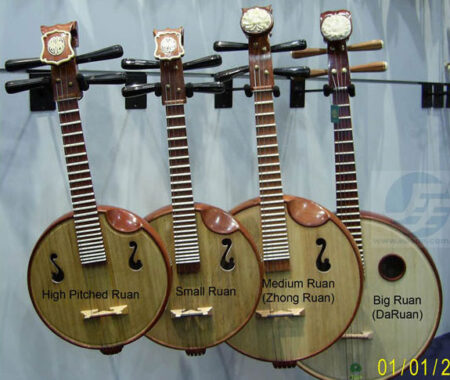
I purchased my Zhong Ruan from Eason Music This shop will supply good quality Chinese musical instruments; they will also answer any question and the website is very good.
The Mohan Veena is an Indian slide guitar, with 3 main strings and chikari strings on the top layer, and about 12 sympathetic strings under the main playing strings.
There seem to be a few copies on the market these days, so here are some details that might help when buying a Mohan Veena.
Vishwa Mohan Bhatt's and Ry Cooder's grammy-winning 1994 album "A Meeting by the River" was a milestone in music history. For the first time musicians outside India took note of Bhatt's instrument, the Mohan-Veena. Bhatt had developed it together with guitar maker Concord. Since 2006, India Instruments offers the original Mohan Veena made by Concord.
In about 2013, Concord has changed the spelling of the brand name to set it apart from inferior replicas. Since then, true original Mohan Veenas made by Concord Musical Industries bear the lettering Conchord instead of Concord - with an H after the second C - at the top of the peg box. The top usually has a label with the name Bhaba Sindhu Biswas, a drawing of Bhabasindhu Biswas and the name Conchord - again with the H.
Details on how to tune The Mohan Veena.

Vishwa Mohan Bhatt uses the following tuning and stringing for his Mohan-Veena:
Playing Strings 1. d / Sa - steel 0.35 mm 2. A / low Pa - steel 0.50 mm 3. D / low Sa - bronce 0.55 mm
Drone Strings (Chikari) 1. c# / low shuddha Ni - steel 0.27 mm 2. F# / low shuddha Ga - steel 0.40 mm 3. A / low Pa - steel 0.35 mm 4. d / Sa - steel 0.27 mm 5. d' / high Sa - steel 0.22 mm
Sympathetic Strings (Taraf) - all steel 0.22 mm 1. d / Sa 2. c# / low shuddha Ni 3. d / Sa 4. e / shuddha Re 5. f# / shuddha Ga 6. f# / shuddha Ga 7. g / shuddha Ma 8. a / Pa 9. b / shuddha Dha 10. c# / shuddha Ni 11. d' / high Sa 12. e' / high shuddha Re
This tuning is based on a d-major scale (Bilawal Thata). For other scales (Thata) the sympathetic strings and occasionally also the 1st and 2nd drone strings are changed accordingly.
Please note that I keep my Veena tuned a semi-tone lower than this tuning.
When trying to purchase a pipa there didn't seem to be any quality instruments on offer. Most of the instruments for sale on line were poor quality, made with plastic parts. In the end I tried a company in China Sound Mountain This turned out to be a good move, for about £400 I got a super quality instrument, shipped to the UK, with no duty paid. I only wish I had spent more money, well recommended.
It is quite difficult to buy an erhu in the UK. When looking for an example I was shocked to find that you can still import with a Cites certificate an erhu made from wild Boa.
You can purchase synthetic skinned instruments but in the end I was lucky to find 2 old instruments that had been shipped to England many years ago.
Hard to find but I can recommend Jali Bakary in Bromley by Bow, who teaches face to face and online.
Getting the keyboaed room ready for new students

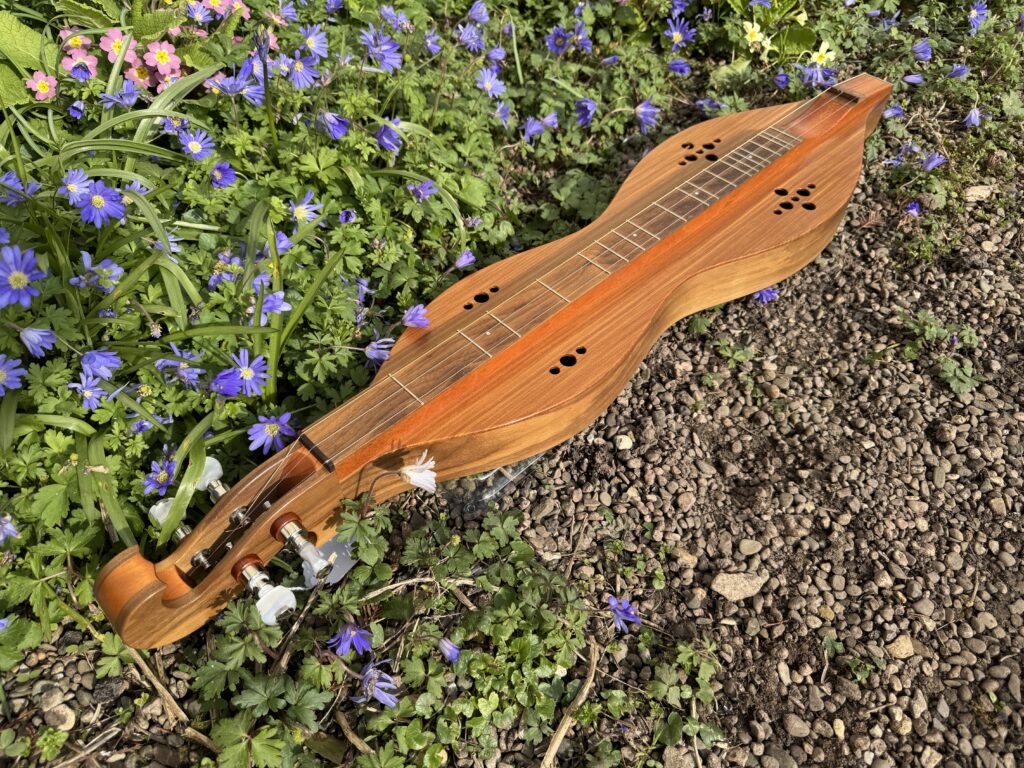
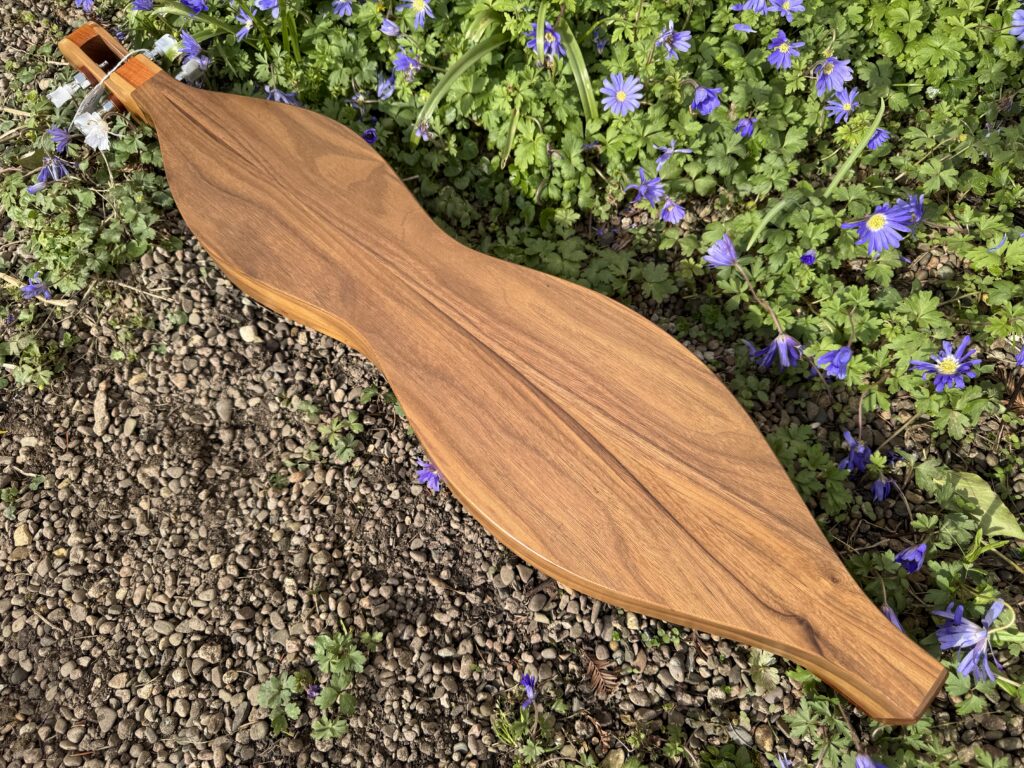

Blue Lion Dulcimers are not taking orders at the moment, there waiting list was over 18 months.
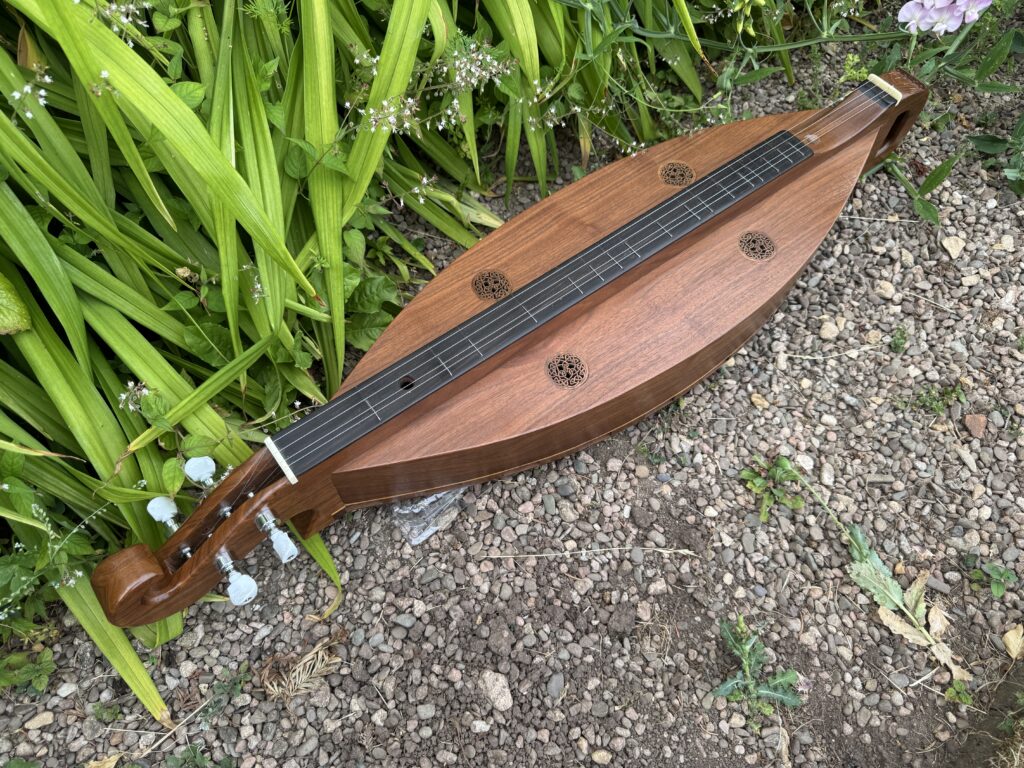
Light blue oblong label, overprinted in darker blue: “FEB. 2, 2001 Blue Lion, RMB JLB [signatures Santa Margarita, California, Model ‘1C’ Serial No. 3103 Simpler Style I body without trimmings, but same size and quality of build. All cherry body, book matched on back and sides. Straight- (and fine-) grained cedar top with signature Blue Lion soundholes, comprising an elegant array of holes in different sizes. Wide headstock with simple scroll/hook, comprising a sandwich of Honduras Mahogany faced with cherry and fitted with high quality Schaller planetary geared banjo tuners, mounted on mahogany spacers. Fingerboard also mahogany, but with no overlay as the Style II. 6+ and 13+ frets present. Rosewood nut and fully compensated floating bridge, both cut for 3 or 4 course string layouts. The tail is plain and slightly convex, with mushroom-headed pins acting as anchors, a fret on top of tail as a strainer. Strap buttons on tail and round far side of head. Overall length 36”, upper bout 6⅛”, lower bout 7½”, depth 2¼”, FBW 1½”, VSL 26⅜” (short/medium scale), weight 2lb 0oz (896g), strings 12/[12], 15, 23w. 6+ and 13+ frets.
Well looked after example of this classic body design from a good middle period. This is beautifully built, following the usual high Blue Lion standards. The big cherry hourglass however produces a different sound from its walnut or rosewood sisters. This is open and clear but quite loud and forward-sounding, well-balanced but distinctly brighter than the usual BL – despite its soft cedar top. Slight wear on the lower frets. A few marks on the soft cedar top, notably to the nearside of the fingerboard as a result of a trailing finger, but overall in excellent condition.
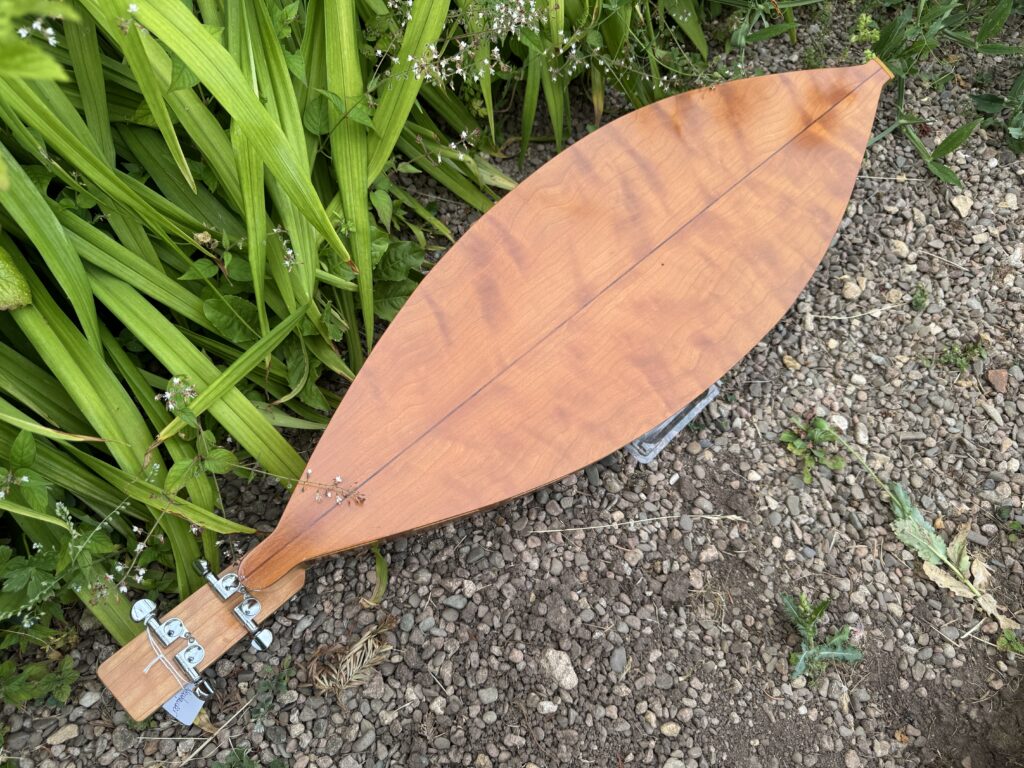
Don Neuhauser [sign]/ 7914 Hidden River Trace/ Charlestown, IN 47111/ Curly Cherry and Rosewood”.
Spectacular curly cherry sides and bookmatched galax back with central purfling strip; spruce inner back and top, latter with simple circular soundholes. High and narrow fingerboard with softwood core and rosewood overlay; softwood traditional galax D-shaped tail. Flat cherry headstock with rosewood overlay and MoP star, fitted with enclosed Grover tuners. Holes through to body, in traditional style, between 1st & 2nd frets, and in strum hollow. Four identical equidistant strings, tuned in unison, for noter style play. Overall length 37″, bout 9¼”, depth 2¼”/2¾ with galax back, FBW 1⅛”, VSL 25¾” (medium scale), weight 3lb 0z (1363g). String sizes all 0.010. No 6+ or 13+ fret.
This is a very special instrument, having been made for one of the premier old-style noter dulcimer players, Bonnie Russell. Bonnie was a child prodigy on the dulcimer, taking the featured role in a famous 1972 recording of the Russell Family entitled “Mountain Dulcimer – Galax Style”. She learned from her mother’s family, the Meltons, who were famous players and makers of galax dulcimers. The instrument is in excellent condition, having been owned and cared for by Robin Clark of Bird Rock Dulcimers in Wales – himself an internationally-known expert in noter-style dulcimer playing.
Contact us for appointment
Jan 2022
Push Up Player Piano, in good playing condition (now sold)

If you are going to practise the fast compassion of a Rag, it would be better if you had a tabla sample that gets faster as you play, like in a live music performance. These samples are for Teen Tal, 16 beats.
Terry and Philippa teach guitar, piano and 11+ in Colchester. We are always interested to talk about world music and meet like minded people
find more on our blog page
