
I have been teaching guitar for over 20 years. I mainly prepares learners for ABRSM, Trinity and RGT examinations. I run an exam centre for the RGT.
I start most of my young learners with the ABRSM classical guitar syllabus, which uses a classical approach to right and left hand technique. Music reading is also part of the learning, which can also be used for other instruments. I teach scales to all students so they can play in any key.

The new way to take your music exam.
Take your exam from the comfort of your own home, no waiting, less stress for children and parents. Learn your four pieces then record and upload to the exam board. Your teacher will help you choose the best take. All performance awards are accredited by the ABRSM.
I have been using the RGT acoustic exams for over 20 years. I have an incredible pass rate, including grade 8 distinctions. I also run an exam centre for the RGT in Romford, where I teach classes and private lessons.
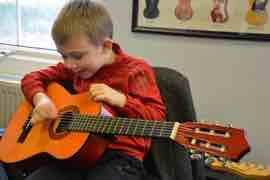
I can start children from 5 years old on guitar. I always use music reading at this young age with classical technique. This is the best preparation you can give your child in any form of music education.
New Working towards a diploma in jazz guitar
If you are going to learn a musical instrument, you will need to practise every week to make progress. I recomend a minimum of 45 minutes per week, split into at least 3 sessions. If you are studying towards an exam, there will certain tasks to do.
For higher grades (ABRSM and Trinity to grade 8 classical guitar), I recommend a warm up going through all your 2 octave scales and arpeggios in all the keys. A small amount of sight reading is a great way to progress.
At this level for classical guitar players I would expect you to be able to play all major scales, two octave root E and A, with their arpeggios. Also I would play melodic and harmonic scales two octave, root E and A, this should be done as a 5 minute warm up at the stat of each practice session. I would recommend some sight reading, about 5 minutes, and then playing and learning your music.
ABRSM oral trainer; this is a usefull App cost about £7 for grade 1 to 5. This is very good for parents to help children with, clapping rythms, repeating melodies and mus more.
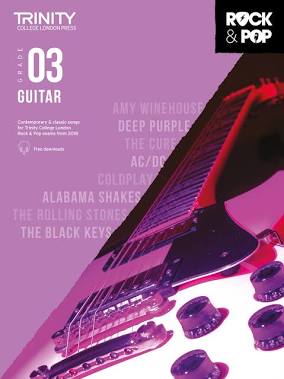
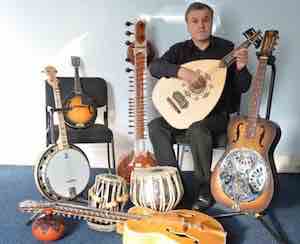
Oz Fest was the last gig I did before lock down. I am now rehearsing a new trio, guitar, keys and vocal. We will be playing some rock but we will be playing mainly pop from the 60's and later, using acoustic guitar and piano.
Below is a typical music assessment. All children will be prepared for this
You will be asked if the rhythm has 2 or 3 beats in the bar.
The melody will be played and then you have to sing it (la, la). This is easy as long as you listen carefully.
You will listen to a melody twice. It will be slightly different either at the beginning or the end and you will have to say which
Music will be played for you to listen to. You must really concentrate and remember the places where the music is loud or quiet. Also, remember where the notes are smooth or not smooth (detached).
This is the distance between 2 notes ie C - E = 3 notes so it's a 3rd, C - G = 5 notes so it's a 5th.
